
Introduction TO NCVT MIS
In India’s rapidly evolving vocational education landscape, the NCVT MIS (National Council for Vocational Training — Management Information System) plays a pivotal role in enhancing transparency, streamlining certification, and tracking trainee progress across Industrial Training Institutes (ITIs). For students, administrators, employers, and policymakers alike, NCVT MIS is more than just a data portal: it’s the backbone of India’s skill development mission. This blog will walk you through everything—from its purpose and architecture to real-world use cases, challenges, and practical strategies to maximize its benefits.
What Is NCVT MIS?
History and Background
The NCVT (National Council for Vocational Training) is an advisory body established under the Government of India. It develops standards and curricula for vocational training trades and awards national trade certificates.
To support a centralized, digitized system for ITIs and apprentices, the NCVT MIS platform was created. According to the MSDE (Ministry of Skill Development and Entrepreneurship), the MIS provides a one-stop information source for all institutes, courses, trainees, and certification processes.
Purpose & Objectives
The primary objectives of NCVT MIS are:
-
To create data transparency across institutions, trainees, and trades.
-
To manage and issue e-certificates, mark sheets, legacy (older) certificates, and trade documentation.
-
To support apprenticeship tracking via a public portal, where trainees, establishments, and regulators can interact.
-
To provide analytical dashboards for policymakers: trade statistics, trainee dashboards, grading, and results.
-
To enable student profile verification before exam hall ticket generation, reducing post-exam grievances.
How NCVT MIS Works
To understand NCVT MIS better, it’s important to look at its modular structure and the roles different users play.
Key Modules
NCVT MIS is organized into several functional modules:
-
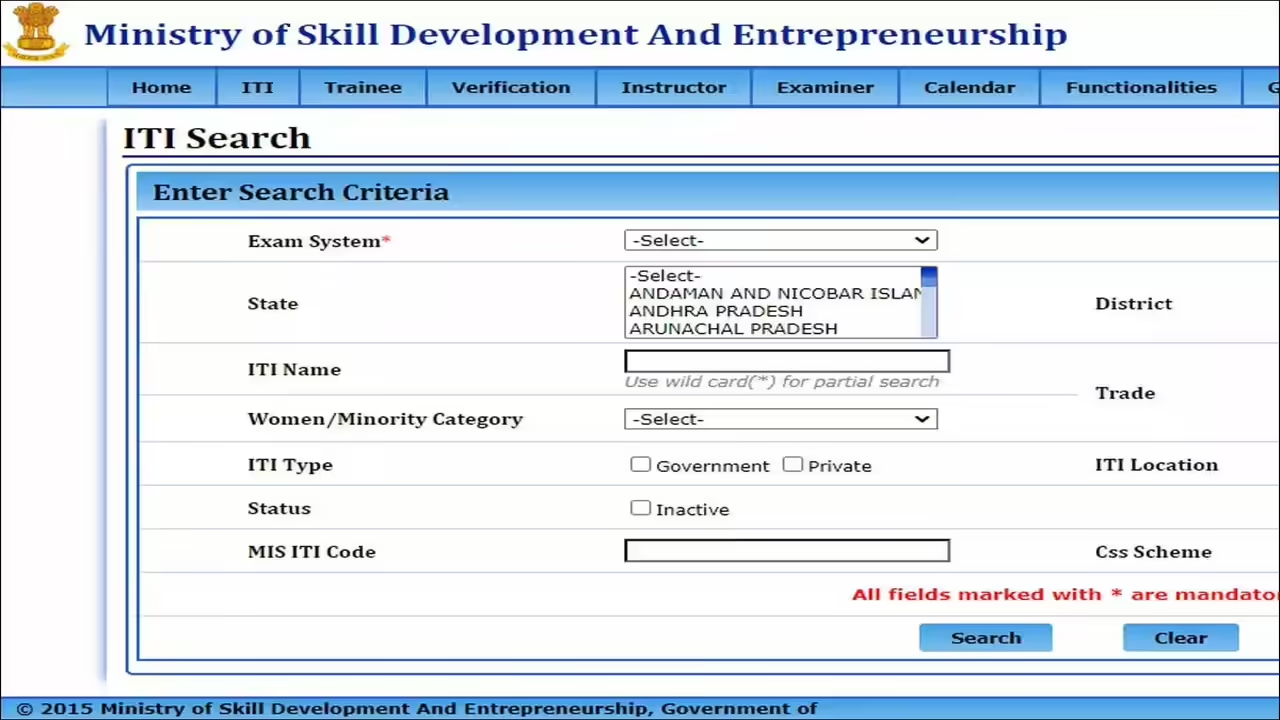
ITI: This module allows users to search for ITIs (Industrial Training Institutes), see trade statistics, view institute grading, and more.
-
Trainee: This includes trainee search, profile management, verification, and viewing marks, certificates.
-
Instructor / Examiner: Registration and search functionalities are available for instructors, examiners, and administrative staff.
-
Apprenticeship: Establishment registration, apprentice application, and progress tracking are done here.
-
Calendar: Academic and examination calendars for planning and scheduling.
-
Verification: e‑Certificate verification, legacy certificate validation, and mark sheet verification.
User Roles & Access
Different stakeholders access NCVT MIS with different privileges:
-
Trainees / ITI Students: They can log in using their registration number or PRN (Permanent Registration Number), check marks, download admit cards, and access certificates.
-
ITI Administrators: They maintain trainee records, upload sessional marks, manage grievances, and ensure data accuracy.
-
Employers / Public: They can verify certificates, check trainee certification status via the public portal.
-
Government / Regulators: Use dashboards for annual results, trade statistics, grading, and evaluating policy outcomes.
Core Features & Functionalities
NCVT MIS is rich in features. Here are its core functionalities explained.
ITI Search & Trade Statistics
-
On the dashboard, users can filter ITIs by state, district, type (government/private), sector, trade, and NSQF level.
-
It displays total trade count, seat count, trainee count, and seat utilization. For example, at a given point, the dashboard showed more than 3.27 million total seats across trades.
-
This transparency helps students choose which ITI or trade to enroll in, and helps policymakers identify gaps in skill development.
Trainee Profile & Verification
-
Trainee profiles include personal data, trade, academic session, exam history, and certification status.
-
There’s a verification module before hall ticket generation: trainees verify their name, date of birth, photo, parents’ names—if there’s an error, they can raise a grievance. This helps ensure correct certificates and reduces post-exam disputes.
-
The portal provides access to legacy certificates for older qualification formats (NAC Legacy, NTC Legacy).
E‑Certificates, Mark Sheets, and Legacy Certificates
-
Once a trainee completes their trade test or course, they can download e‑mark sheets, e-certificates, or legacy certificates using the MIS portal.
-
These are digital, verifiable, and secure, reducing the risk of forgery and making verification by employers simpler.
Academic / Examination Calendar
-
The MIS has a Calendar module that shows both academic schedules and examination timelines.
-
This helps ITIs plan practical exams, CBT (Computer Based Test), and other assessment tasks.
Grading, Dashboard & Analytics
-
The Dashboard provides reporting for different stakeholders: “Admitted Trainee Dashboard,” “Semester Result Dashboard,” “Annual Result Dashboard,” etc.
-
Administrators and regulators can see grading of ITIs, performance trends, and other key metrics.
-
These insights facilitate data-driven decision-making.
The Impact of NCVT MIS
Transparency & Accountability
The MIS portal brings transparency to vocational training by making key data publicly accessible: institute count, trade seats, trainee numbers, and performance metrics. This promotes accountability in ITIs and allows students to make informed decisions.
Efficiency in Certification & Verification
Issuing e-certificates and making them verifiable online reduces delays and eliminates the hassle of physical paperwork. Employers can instantly verify a trainee’s credentials, reducing hiring risk.
Data-Driven Policy Making
With dashboards for annual and semester results, grading, and trade statistics, policymakers and regulators get real-time data to spot inequalities, assess trade demand, and plan capacity building. The MIS supports this with detailed reporting.
Skill Development & Placement Facilitation
By tracking trainees’ performance, certification, and post-training placement (through partner institutions or public data), MIS can contribute to better alignment between training programs and industry needs.
Use Cases and Examples
Here are real-world (or realistic) examples of how different users interact with NCVT MIS.
ITI Student Using MIS
Rahul’s Journey
-
Rahul enrolls in a two-year electrician trade at a government ITI.
-
He registers on the MIS portal with his registration number (PRN) and fills out his profile.
-
Before his semester exam, he logs in to verify his personal details. The “Profile Verification” module allows him to correct any errors in his name or date of birth. ncvtmis.gov.in
-
After completing exams, Rahul logs back into his MIS profile: he downloads his e-marksheet, then later his e-certificate.
-
He then shares his certificate with potential employers, who verify it online through the MIS public portal.
Employer Verifying Certificate
Manufacturing Company
-
A manufacturing firm is hiring fresh ITI graduates for electricians and fitters.
-
During recruitment, the HR team asks candidates to submit their NCVT certificate.
-
Instead of physical verification, the HR uses the MIS “Certificate Verification” module to validate each candidate’s credentials instantly. login.ncvtmis.gov.in
-
This not only saves time but reduces the risk of hiring unqualified or fraudulent candidates.
Government / Directorate Using Dashboards
State Skill Development Authority
-
The nodal skill development authority logs into the MIS dashboard.
-
They filter data for all ITIs in their state, examine trade-wise “seat utilization” and “trainee pass rates,” and identify that certain trades are underutilized.
-
Using this insight, they allocate additional funding, promote outreach for those trades, or close underperforming courses.
Challenges & Limitations
Despite its strengths, NCVT MIS also faces several challenges.
Technical Issues
-
According to the NCVT MIS FAQ, sessions timeout after 30 minutes of inactivity. ncvtmis.gov.in
-
Also, for functions like entering sessional marks, pop-up windows may be blocked by browser settings, hindering usability. ncvtmis.gov.in
-
Some users may face login problems if business unit dropdowns (identifying their ITI) don’t populate correctly. ncvtmis.gov.in
Data Accuracy & Profile Mismatches
-
Trainees entering wrong personal details (name, DOB) can lead to mismatches. Though there is a grievance option, this takes time and may delay certification.
-
Legacy data (older certificates) may not always be digitized properly, causing gaps in historic information.
Adoption by Small ITIs / Private Institutes
-
Smaller or private ITIs may lack capacity or digital literacy to maintain MIS data accurately.
-
Some institutions may not regularly update trainee/marks data, reducing the quality of analytics.
Digital Literacy Among Trainees
-
Many trainees come from semi-urban or rural backgrounds, where digital literacy or consistent internet access can be limited.
-
This can make it difficult for them to interact with MIS modules, download certificates, or verify their own data.
Actionable Insights: Best Practices for Stakeholders
Here’s how different stakeholders can maximize the value of NCVT MIS.
For ITI Administrators
-
Regularly audit trainee profiles: Before exams, use the profile verification module to ensure all details are correct.
-
Train staff on MIS usage: Organize workshops for admin or ITI staff to properly upload marks, update attendance, and manage trainee data.
-
Promote digital certificate adoption: Encourage trainees to download their e-certificates and understand how verification works.
For Trainees / Apprentices
-
Complete profile accurately: Make sure you enter correct name, date of birth, and parent details, and verify before your exam.
-
Use the portal actively: Log in to check marks, download e‑certificates, and keep digital copies for future use.
-
Raise grievances early: If there is a mismatch in your profile, use grievance tools well before your hall ticket / certification needs.
For Employers
-
Use e-certificate verification: Instead of relying solely on physical copies, verify candidate credentials via MIS portal.
-
Engage with ITIs: Encourage ITIs to ensure their trainees are properly registered and certified via MIS.
-
Provide feedback: If you find systemic verification issues, raise them with regulatory bodies or feedback mechanisms.
For Policymakers
-
Leverage dashboard analytics: Use MIS dashboards to identify skill gaps, underperforming trades, and resource allocation needs.
-
Promote MIS integration: Advocate for integrating MIS data with broader skill development initiatives, apprenticeship schemes, and placement agencies.
-
Support capacity building: Fund digital training programs for ITI administrators and trainees to improve data quality and portal adoption.
Statistics & Recent Trends
Here are some relevant statistics and trends highlighting the scale and importance of NCVT MIS:
-
The MSDE Annual Report 2023–24 notes that e-certificates (NTC, NAC) are now issued via the NCVT MIS portal.
-
MIS supports CBT (Computer Based Tests) for theoretical examinations, reducing result-processing time and enhancing exam efficiency.
-
According to the MIS dashboard, there are 150 trades listed with over 3.27 million total seats.
-
The system’s trainee profile verification before generating hall tickets has reduced post-exam certificate disputes significantly, as reported in the MSDE report.
Frequently Asked Questions (FAQs)
Here are some FAQs about NCVT MIS, based on official documentation and user concerns.
Q1: What is the official website of NCVT MIS?
A: The official MIS portal is ncvtmis.gov.in.
Q2: How can I download my NCVT ITI admit card?
A: Log in to the trainee portal using your PRN/Registration No. + Date of Birth, then go to the Admit Card section.
Official portals like Skill India Digital Hub often mirror these links.
Q3: How do I download my e-certificate from NCVT MIS?
A: Once logged in as a trainee, go to the “Trainee Profile” or “Documents” section to access e-marksheets or e-certificates.
Q4: My MIS session keeps timing out. What can I do?
A: The default session timeout is 30 minutes. ncvtmis.gov.in If you’re kicked out unexpectedly, change your password (in case someone else is logged in), and avoid sharing your credentials.
Q5: I entered wrong personal details when registering. Can I correct them?
A: Yes — during the “Profile Verification” stage (before hall ticket generation), you can raise a grievance to correct name, date of birth, or photo.
Q6: How can an employer verify a trainee’s certificate?
A: Employers can use the “e-Certificate Verification” tool on MIS public portal by entering certificate number or trainee details.
Q7: What if my browser blocks pop-ups when entering sessional marks?
A: That’s a known issue: the marks-entry window opens in a new popup. Make sure your browser’s pop-up blocker is disabled.
Q8: Is NCVT MIS used for apprenticeships as well?
A: Yes. There is a dedicated apprenticeship module where institutions register, apprentices apply, and both parties track progress.
Conclusion
The NCVT MIS portal is an indispensable tool in India’s vocational education ecosystem. It bridges multiple stakeholders — students, ITIs, employers, and policymakers — through a unified digital platform. By offering features like trainee verification, e-certificates, dashboards, and trade statistics, it promotes transparency and efficiency. While technical challenges remain, its positive impact on certification, skill development, and data-driven governance is undeniable.
Call to Action (CTA)
If you’re an ITI student or apprentice, log in to NCVT MIS today: verify your profile, download your e‑certificate, and keep your records up to date — it’s your digital proof of skill.
If you’re an employer, use the e-certificate verification tool to confirm credentials quickly and securely.
And if you’re an administrator or policymaker, tap into the MIS dashboards to understand training gaps, optimize resource allocation, and strengthen skill-building initiatives.
Visit https://ncvtmis.gov.in now to explore these functionalities and leverage the full power of NCVT MIS.